22.08.2015
Economic Research Service (ERS)
The Middle East and North Africa (MENA) region accounts for a significant and growing portion of worldwide food and feed imports. Despite the violence and political uncertainty hanging over parts of the region, the MENA’s growing populations and rising incomes are driving higher demand for major food and feed grains, soybeans, cotton, and meats. This demand cannot be fulfilled by domestic production alone given the region’s climatic and geographic constraints, thus creating a large need for food imports. The United States has historically played an important role in meeting this region’s food needs, but recently, new exporters from South America, Europe, and Asia have emerged to compete for the MENA region’s market share, exploiting various production and transport cost advantages. For certain commodities, the effects of this new competition have translated into fewer U.S. shipments to the MENA and a smaller share of the region’s market.
Meat consumption is correlated with income around the world, and the Middle East and North Africa (MENA) region is no exception.
While income levels vary widely across the region, income growth continues to outpace the world average with implications for MENA's future meat demand, particularly poultry.
Per capita meat consumption has more than doubled from around 12 kilograms (kg) in the 1990s to about 24 kg in 2010, and USDA's Baseline Projections suggest this growth will continue well into the future.
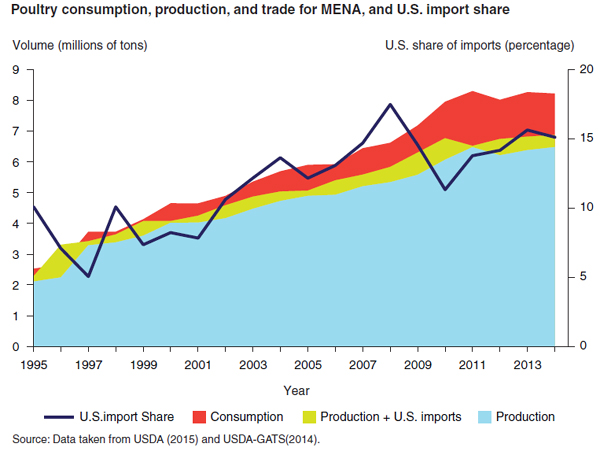
As with other commodities, the growth of poultry consumption has exceeded gains in domestic production, leading to rising imports, and MENA is now the largest regional importer of poultry products in the world.
The MENA region’s poultry consumption and production have risen consistently over the past 15 years. As with other commodities, the growth of poultry consumption has been exceeding gains in domestic production, leading to rising imports, and MENA is now the largest regional importer of poultry products in the world. Saudi Arabia remains the region’s largest buyer, with total imports over the last decade rising about 4 percent annually, reaching 700,000 metric tons in 2013. Close behind is Iraq, with total imports expanding by over 400 percent over the same period. U.S. poultry shipments, which consist mainly of broilers, saw rapid growth over the past 10 years, with quantities reaching around 350,000 metric tons in 2013, accounting for about 15 percent of the region’s poultry imports. Destinations within the region for U.S. poultry are different than for other commodities, with the biggest customers, Iraq and the UAE, accounting for 30 percent and 20 percent, respectively, of total U.S. shipments to the MENA. Over the last decade, MENA imports from the United States have grown more than 10 percent per year. The largest U.S. competitor for this market is Brazil, the world’s largest poultry exporter, but Turkey has emerged as an important local supplier within the region.